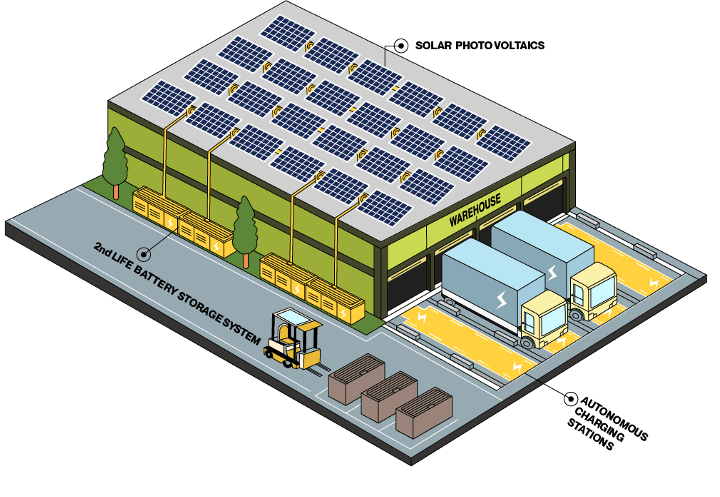
The research project “Circular Electrification Solutions for Decarbonized Freight Transport” is a pioneering initiative aimed at transforming the commercial road freight transport sector in the European Union, particularly focusing on Sweden. This sector, while only comprising about 2% of all vehicles on the road, is responsible for over 23% of greenhouse gas emissions in the transport sector [1]. The project contributest to the goal of significantly reducing carbon emissions from the heavy haulage industry by 70% by 2030 and to achieving a net-zero carbon footprint by 2045.
The project addresses the challenge of decarbonizing the freight transport sector through a holistic approach, integrating circular electrification solutions. This includes the use of on-site electricity generation from photovoltaic panels, combined with second-life energy storage systems, to charge vehicles on autonomous charging platforms. Additionally, it involves converting existing internal combustion engine trucks into battery-powered electric vehicles (BEVs). The consortium leading this effort consists of a university (Örebro University), a transport group (Närkefrakt), a charging ecosystem technology provider (Elonroad), and a local policy maker responsible for transport infrastructure (Region Örebro Län).

The project’s research questions focus on three main areas: developing business models and incentives for a circular charging ecosystem, technological interoperability and safety regulations for the proposed solutions, and changes to business practices and behavior for transport providers. The approach emphasizes the circular economy model, where industrial systems are designed to be restorative or regenerative, and emphasizes closed-loop material cycles, renewable energy sources, and systems thinking for continuous business collaboration and circular value creation [2].
The project uses a transition design approach as its main scientific framework, utilizing backcasting workshops to understand stakeholder perspectives and co-create visions for a future sustainable road freight system [3]. It contributes to the ongoing debate on achieving a fossil-free freight transport future in Sweden by exploring the circularity potential of the sector, thereby addressing the interconnected uncertainties of transport operators regarding electrification. Moreover, it seeks to bridge existing gaps in scientific literature by exploring novel business models and collaborative actor-centered design and planning processes to accelerate low-carbon transitions.
The theoretical underpinnings of the project are grounded in the socio-technical transition approach to system innovations. This approach addresses environmental challenges through major changes in various socio-technical systems, incorporating both production and consumption aspects, as well as cultural, political, and infrastructure-related elements. The project aims to understand systematic innovations for sustainability purposes and explores how societal developments influence and interact with potential technological regimes.
In summary, the “Circular Electrification Solutions for Decarbonized Freight Transport” project is a significant step towards a sustainable and eco-friendly freight transport sector. Its integrated and interdisciplinary approach, combining technological innovation with business model transformation and policy development, positions it as a critical contributor to Sweden’s goal of a circular economy and a low-carbon future in freight transport [4].
References:
[1] Transport & Environment (T&E) (2022). European environmental, health and consumer groups urge Commission to make all new trucks zero emission by 2035. https://www.transportenvironment.org/dis-cover/european-environmental-health-and-consumer-groups-urge-commission-to-make-all-new-trucks-zero-emission-by-2035
[2] Korhonen, J., Nuur, C., Feldmann, A., & Birkie, S. E. (2018). Circular economy as an essentially contested concept. Journal of Cleaner Production, 175, 544-552.
[3] Irwin, T. (2019). The emerging transition design approach. Cuadernos del Centro de Estudios en Diseño y Comunicación. Ensayos, 73, 147-179.
[4] Fossilfritsverige, (2017). Färdplan för fossilfri konkurrenskraft. https://fossilfrittsverige.se/wp-con-tent/uploads/2020/10/ffs_sammanfattning2020.pdf
 CIRC-S Project Website