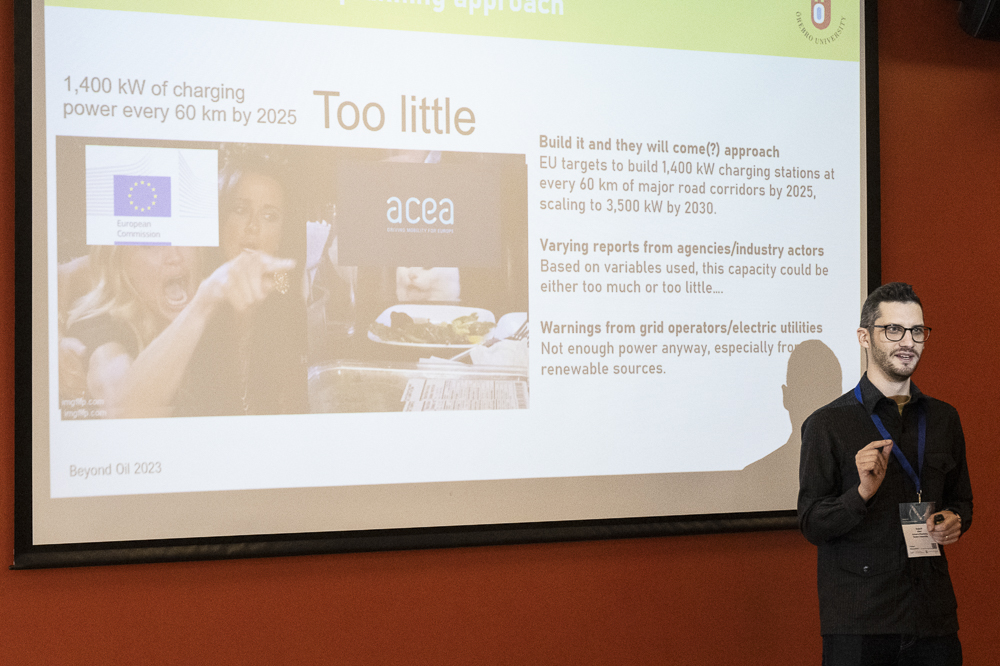
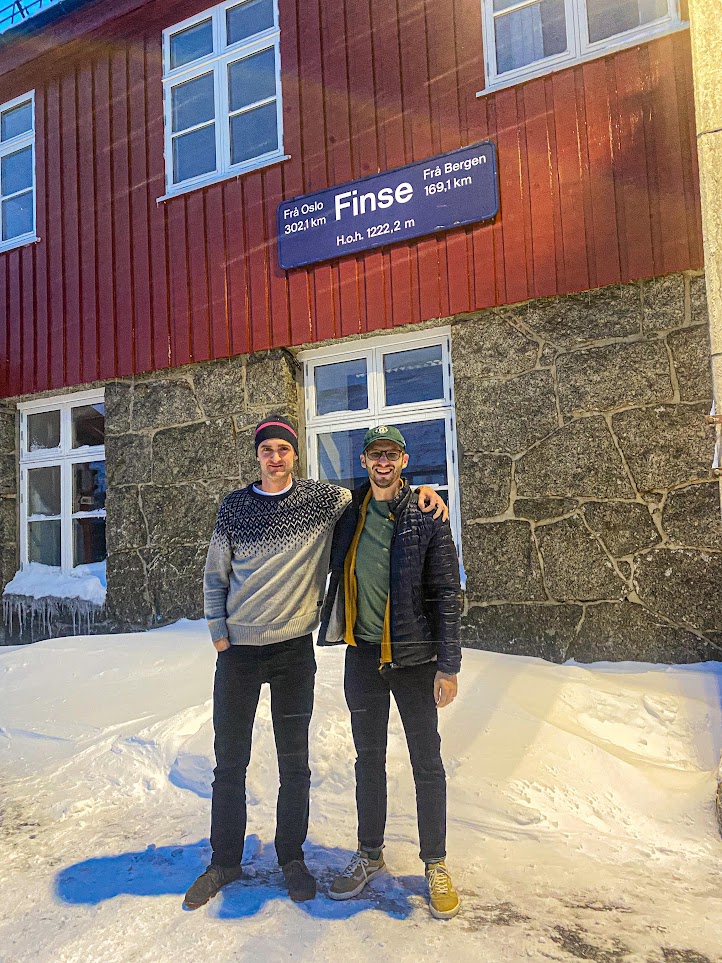
Beyond Oil is a biennial conference held at the University of Bergen, organized by the Centre for Climate and Energy Transformation. In the words of the organizers, the conference addresses the urgent and challenging task of transitioning to low-carbon societies amidst multiple crises and setbacks. Since the dates for the 2023 edition coincided nicely with the start of our project, we took advantage of this and decided to participate. Since our project focuses on sustainability, we were responsible citizens and took the buses and trains all the way and even saw the first snow for the year on the way from Oslo to Bergen.
The program included a range of plenary and parallel sessions on various topics such as the paradoxes of just transitions, networks of energy, local transformations, perspectives on a just transition, and transforming freight logistics, exploring the policy, practice, technology, public discourse, and spatial tensions that contribute to (or hinder) the sustainability transition. The parallel sessions were organized in a very interesting way with very short presentations (turns out it is really hard to present your research in 8 minutes!) and relatively long discussions in smaller groups, which leads to more interesting and detailed feedback.
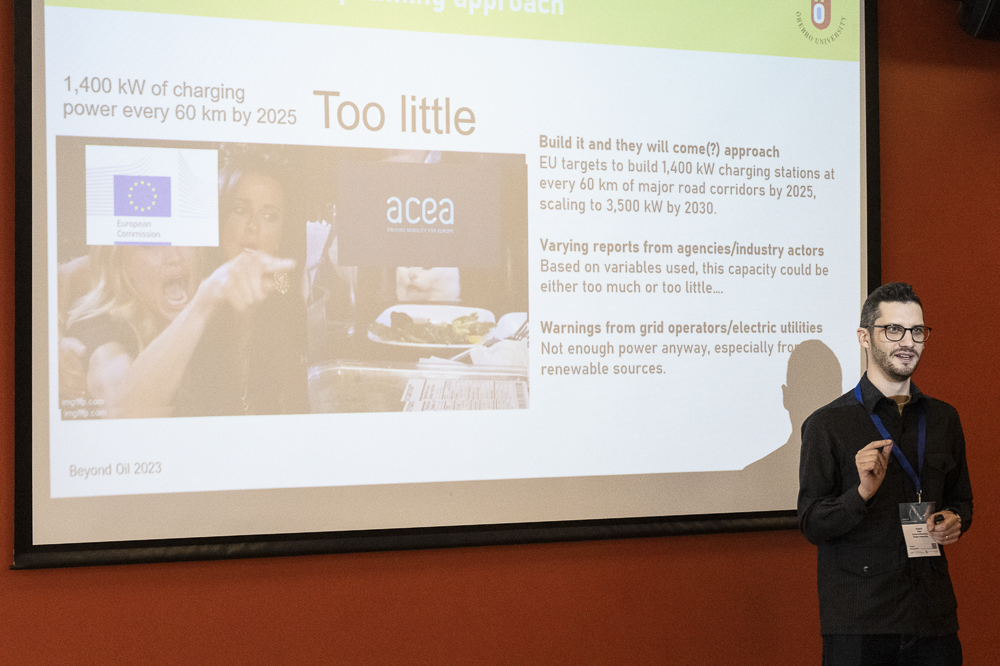
We presented two papers at the conference: Sophie-Marie wrote a paper, which was presented by Vojtech, focused on the need to change the approach in which major infrastructure projects are planned if we want to decarbonize freight logistics. The traditional approach (also called Predict & Provide), where future needs are predicted and transport infrastructure is subsequently built. However, in case of the electrification, this approach tends to reduce the complexity of the transition (e.g., it is not as simple as replacing gas stations with charging stations when it comes to freight vehicles with very large batteries), and very often clashes with real-world adoption of novel technologies. Therefore, we argue for a switch for new paradigm: so called sufficiency planning. Sufficiency planning for road freight transport electrification is a strategy that aligns electrification efforts with ecological constraints and societal needs, ensuring that energy demand and GHG emissions are minimized while maintaining essential transport functions within evolving cultural and spatial contexts. Full version of the paper coming up as a part of Sophie-Marie’s dissertation!
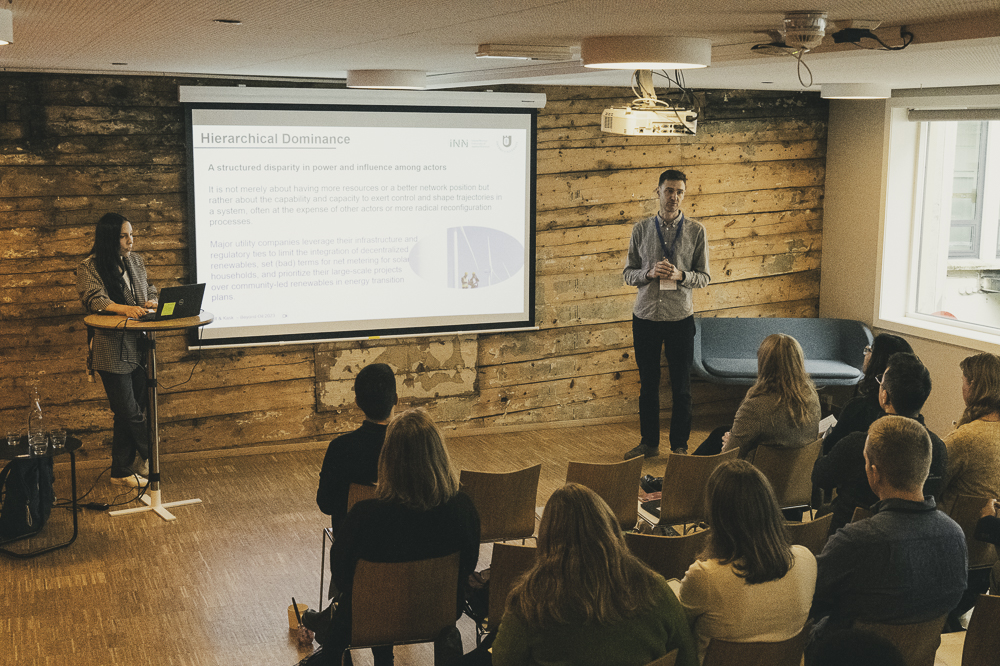
Johan and Sophie-Marie also presented their work on the role of non-harmonic relationships in low-carbon transitions, challenging the prevailing emphasis on harmonious interactions within transition research. They argue that conflict and competition are significant in shaping the direction and pace of the transition towards a low-carbon society, using the electrification of the Swedish road freight sector as a case study. Their findings suggest that acknowledging these dynamic relationships is crucial for policymakers and managers in making strategic decisions for sustainable transitions. The paper is a work in progress.
It was a very nice experience overall, interacting with a different crowd than we are used to from purely business conferences. The perspectives were much wider and included sociology, psychology and geography. We sometimes even felt as the outsiders, talking about how to help companies to be more sustainable, which was much less radical than some of the other contributions. However, this made the conference much more interesting and enjoyable in the end!
We look forward to Beyond Oil 2025.
 CIRC-S Project Website