In the newest academic publication from our project, our team members Sophie-Marie, Zeinab, Vojtech and Johan explore the inadvertent effects of tech neutrality on the adoption of zero-emission vehicles (ZEVs).
For years, tech neutrality has formed the backbone of policy making principles: it dictates that it is not the policy makers who should decide which of the emerging technologies is the winning one and should be widely deployed. Instead, it is the market forces that eventually pick the most cost-effective technology. In our case, we set up to study whether this principles might have some unwanted effects on adoption of zero-emission trucks in the Swedish road freight transport context.
We based our study on a national survey (with 155 participants) of Swedish transport operations managers of haulier companies, incorporating concepts from psychology and consumer marketing. In short, we study how Perceived technological neutrality affects Anticipated regret (emotional response to potential future loses coming from a decision), and subsequent decision to delay a ZEV Adoption (and we also take into consideration how the individual perceives the rate of technological change).
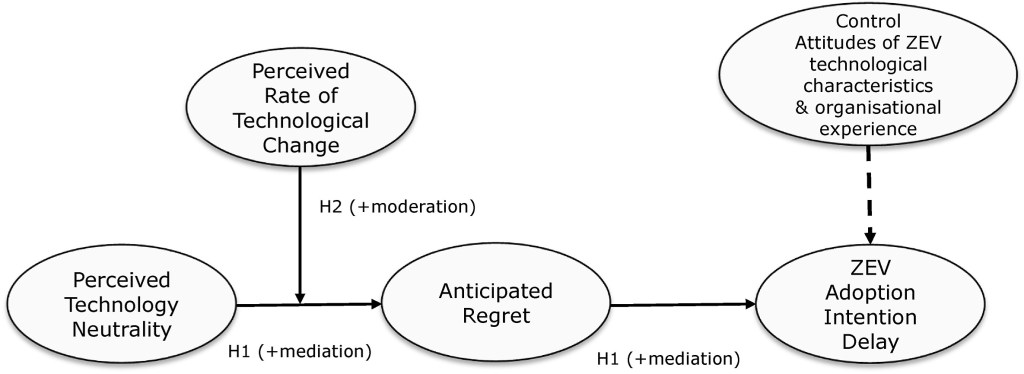
We find that there is a strong correlation between managers’ perceptions of a technology-neutral policy mix and their decision to delay zero-emission truck adoption: Managers who perceived the policy mix as highly technology-neutral expressed more anticipated regret about prematurely adopting the “wrong” vehicle technology, influencing the decision to postpone zero-emission truck adoption. We also find that those who already have experience with ZEV adoption are less likely to show regret and to delay their adoption overall, suggesting that the policy mix that would enable trying out or piloting ZEV adoption for companies could be successful.
In conclusion, we find that the relationships between policy, individual emotional and rational responses and resulting organizational actions are even more complex than previously thought. Future policy mix makers should thus take these interactions into consideration to design more inclusive policy mix fostering low-carbon transitions.
This paper is a part of Sophie-Marie’s coming PhD thesis. You can read the full version here.
 CIRC-S Project Website