We’re happy to share that LINC – Logistics hubs as INdustrial energy Communities – has been granted funding and will run as a 12-month pre-study during 2026 in the FFI Sweden’s Accelera program managed by Energimyndigheten. In LINC, we explore how logistics hubs can electrify road freight in a way that is more cost-efficient, resilient, and equitable, especially for smaller hauliers who often face the toughest barriers to transition.
What is LINC?
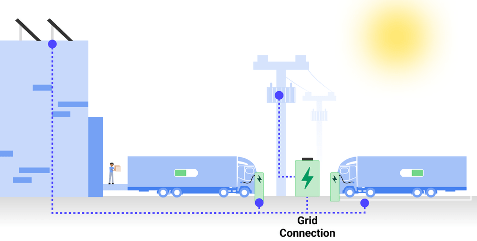
Electrifying heavy road freight is progressing, but the dominant approach – individual depot charging with a near one-to-one charger-to-truck ratio – can become expensive and grid-intensive when many operators are concentrated in the same area. LINC investigates an alternative: turning logistics hubs into “industrial energy communities” where multiple actors can share charging infrastructure, combine it with local renewable electricity generation and energy storage, and coordinate charging through smart energy management.
Logistics hubs concentrate vehicles, energy demand, and operational dependencies in one place. That creates risk (e.g., congestion, outages, peak-load costs) but also opportunity: coordinated solutions at hub level can reduce peak loads, improve resilience, and lower the threshold for electrification, particularly for smaller actors that struggle with large upfront investments.
LINC is closely connected to the ongoing CIRC-S work on circular electrification solutions for freight transport. Several partners overlap, and LINC builds on emerging insights and collaboration structures from the CIRC-S ecosystem, now extending them into a dedicated feasibility study that aims to prepare a future full-scale demonstration project.
Focus of the pre-study
During the pre-study, we will combine modelling and stakeholder engagement to produce concrete results usable for a later demonstration project, including:
- Scenario and system feasibility modelling for shared charging, local renewables, storage and (where relevant) vehicle-to-grid options at logistics hubs.
- Operational requirements and barriers/enablers for hauliers, explicitly including how smaller operators can participate on fair terms.
- A specification of digital infrastructure and value flows (e.g., load management, access control, billing, secure data exchange) needed to make sharing work in practice.
- A roadmap for a future demonstration, including the wider actor constellation needed for scaling (e.g., OEMs, grid operators, municipalities and policy stakeholders).
Project consortium
The project brings together a set of partners with distinct but connected roles. Örebro University contributes system-level modelling, analytical synthesis, and the development of a forward-looking roadmap for future demonstration and scaling. Närkefrakt provides critical operational insights from hauliers and day-to-day logistics hub realities, ensuring that requirements, constraints, and issues of fair and equitable access are grounded in practice. Elonroad brings expertise in charging technology and its integration into logistics hub operations. Finally, we are pleased to welcome ViaEuropa into our network! In LINC, ViaEuropa focuses on the digital infrastructure layer, including interoperability, coordination mechanisms, and the design of value flows needed to enable shared energy and charging solutions.
Do you want to be involved in the project?
We’ll share updates here on the CIRC-S webpage as LINC progresses, especially around stakeholder engagement and the roadmap for the next step (demonstration). If your organization works with freight electrification, logistics hubs, grid capacity, or digital coordination solutions and would like to connect, feel free to reach out, as we are looking for stakeholder group members!
 CIRC-S Project Website